A static drawing already contains a world. We set it in motion.
Abstract
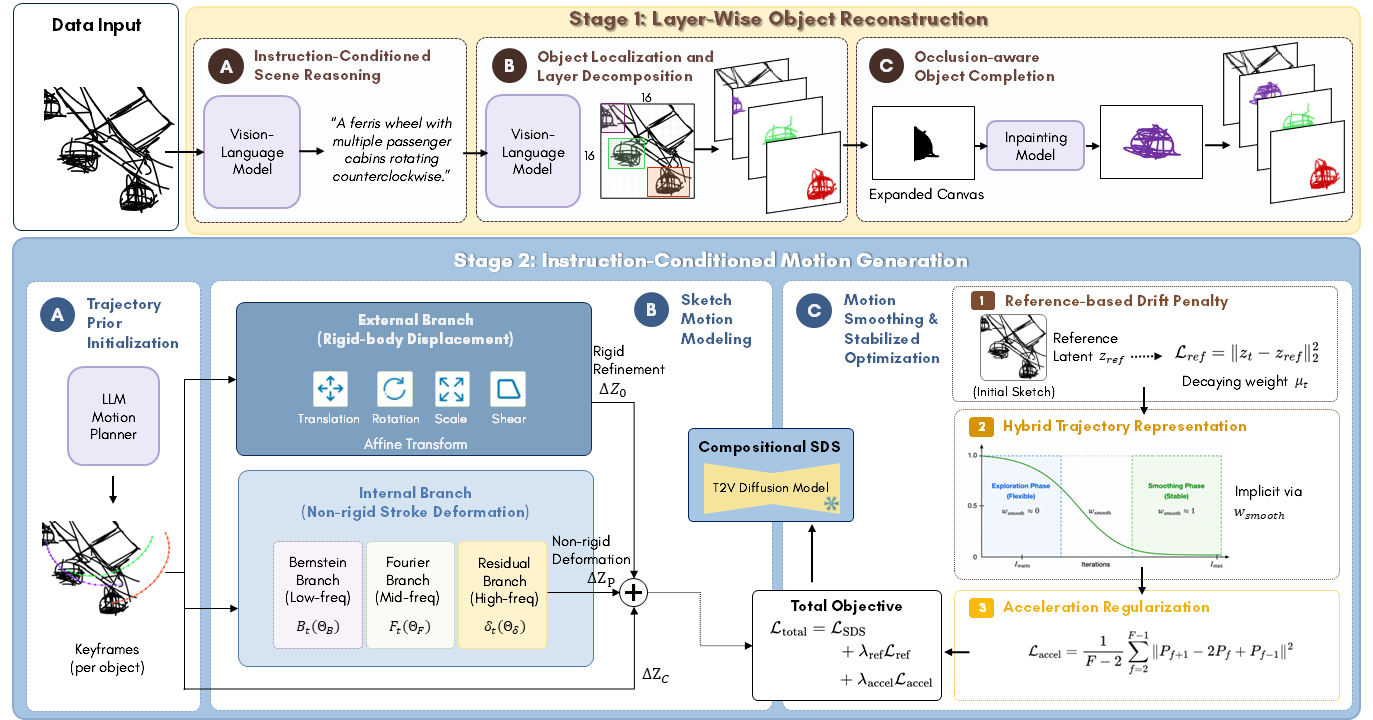
Automatically animating multi-object vector sketches requires understanding scene structure, resolving occlusions, and coordinating interacting elements. OmniScribble reconstructs complete layer-wise vector objects, then combines instruction-conditioned trajectory planning with rigid and non-rigid motion. Sketch-preserving and temporal objectives produce coherent animation while retaining the sparse, expressive character of the original drawing.
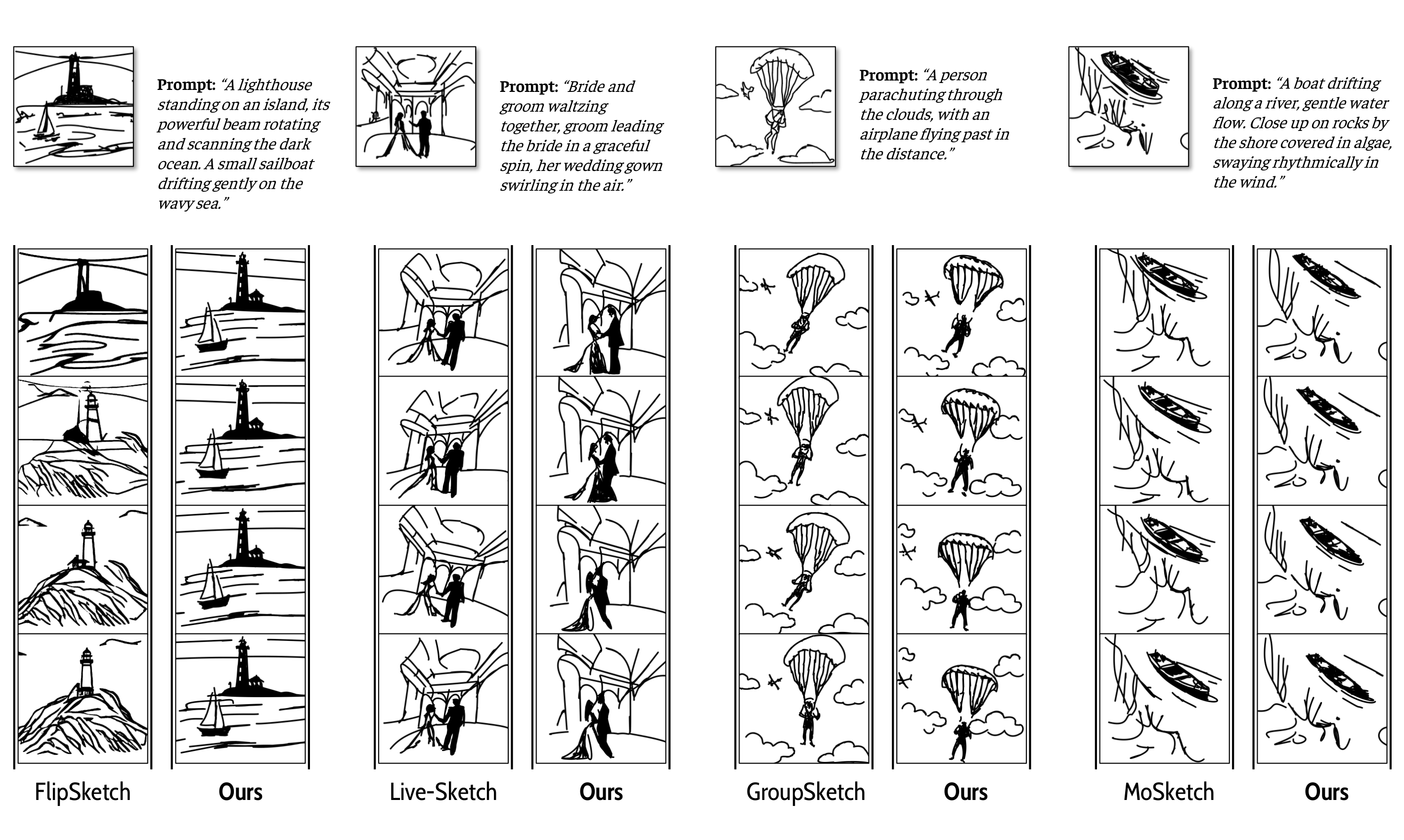
OmniScribble generates smooth and coordinated animations for complex multi-object vector sketches. Unlike prior approaches that suffer from motion jitter, object interference, or extensive manual specification, our method automatically infers object interactions, resolves occlusions, and synthesizes temporally stable, natural-looking motions while preserving the original vector appearance.
02 / Methodology
Reconstruct first. Choreograph second.
The system separates understanding what is present from deciding how every object should move.
03 / Comparisons to Prior Work
Same drawing. Different motion.
Compare every available result for the same source sketch and motion instruction. Use the side arrows to move between samples.
Complete the hidden object. Then animate the whole.
OmniScribble reconstructs geometry behind foreground occluders so each object can move as a complete, independent vector layer.
Loading…
Coming soon
05 / Citation
BibTeX
Cite this work.
@inproceedings{TrinhWACV2027,
  title = {Multi-Object Vector Sketch Animation via Occlusion Resolution and Motion Planning Choreography},
  author = {Trinh, Hien and Le, Trung-Nghia},
  booktitle = {Winter Conference on Applications of Computer Vision (WACV)},
  year = {2027},
}